Why are (some) rent-restricted units vacant during a housing crisis?
Articles in The Oregonian and Willamette Week in December and January reported that nearly 1,900 rent-restricted units sit empty in Portland. Why aren’t these units serving people who need them? This post examines current vacancy rates and their root causes, covering some of the same ground as recent news stories while also digging into nuances and answering some anticipated questions. While we don’t claim to be experts on every factor that influences vacancy rates, this analysis draws on my colleagues’ and my experience as affordable housing asset management consultants, as well as on reports from governments, industry associations, and subject matter experts.
Contributing Trends
Four trends that are shaping the current affordable housing landscape go far to explain the immediate drivers of vacancy, which are described in the next section of this article.
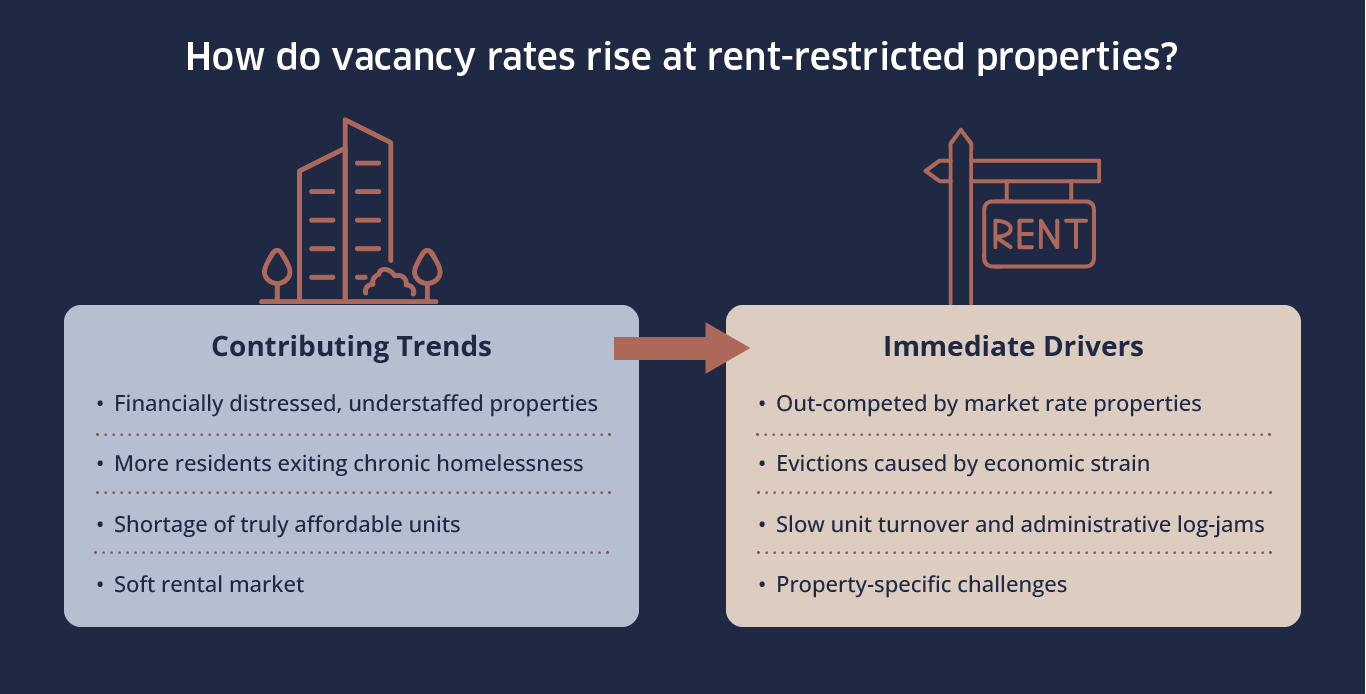
TREND 1: Many properties are financially distressed and understaffed in a challenging post-pandemic operating environment.
It takes resources—staffing, supplies, vendors, and of course, money—to repair, clean, market, and lease a unit. But affordable housing properties are short on these resources today. Since 2020, prices for insurance, maintenance, payroll, utilities, and other essentials rapidly inflated, affecting properties across the country. Operating costs for affordable housing properties in Oregon grew at more than double the projected rate during the past five years, with median operating expenses increasing by over $2,600 per unit per year from 2020 to 2024, according to a 2025 report from national accounting firm CohnReznik.
For rental income to match that expense increase, tenants’ rents (or rent subsidies) would need to increase just as sharply. But rent-restricted properties are limited in how much they can increase tenant rents, and how quickly, and rent subsidies are often inadequate to fill the gap. Owners, especially community-based nonprofits, can’t easily make up the difference after years of challenging financial conditions have eroded their reserves. Operating challenges driven by financial losses contribute to vacancies at many properties.
TREND 2: Many people are exiting homelessness and moving into rent-restricted housing properties—and lack the support they need to recover and stabilize.
People exiting chronic homelessness live with trauma, chronic illness, disability, underemployment, behavioral health issues, and other conditions that are barriers to staying stably housed. Permanent supportive housing (PSH) is a housing model designed to address their needs: the “S” in PSH refers to wrap-around services that support residents’ wellbeing and stability, such as help getting psychiatric care and housekeeping supplies or support understanding lease terms and accessing public benefits. The PSH model is a humane and research-backed solution, and more of these units are needed. But in Portland and across the whole country, there is deficient funding for the costs of operating PSH units, including the cost of providing supportive services.
Public funding has enabled the development of over 1,000 PSH units in Portland over the past decade. Some are located in all-PSH properties, while others are integrated into affordable housing properties where many tenants don’t have histories of chronic homelessness. At an increasing number of properties, many people with serious life challenges are living in dense housing alongside others. Many have insufficient assistance. The result can be what one downtown housing provider recently described as “chaotic and sometimes unsafe housing situations for the entire community.” These chaotic conditions increase turnover among tenants with all kinds of needs and turn away would-be renters. They also contribute to the rising property costs discussed under Trend 1, between major property damage (think floods and fires) and added security costs.
TREND 3: Rent-restricted units that are truly affordable to low-income residents are in short supply, and subsidies to close the gap are limited.
Portland (like the whole state) needs more housing. But it doesn’t have an equal need for all kinds of housing, in every neighborhood, at every income level. A vacant downtown high-rise apartment isn’t useful to a family looking for a house with a yard for the dogs, just as a rent-restricted apartment that costs $1,300 a month isn’t useful to someone leaving inpatient care with no job. The distribution of rent-restricted housing among different affordability (household income) levels is imperfectly aligned to local market needs.
The types of units in greatest under-supply are those affordable to people with the lowest incomes and those experiencing homelessness. The Oregon Housing Needs Analysis shows that 11,600 affordably priced units are currently needed in the Portland-metro area for those making 30% of area median income (AMI) or less, whereas 6,800 units are needed for people making 30% to 60% of AMI. The need is great across the spectrum of what is considered low-income—but it’s much greater on the low end.
Rent-restricted units numbering in the low thousands have been built in Portland in just the last handful of years, including mostly 60% AMI units along with more than 1,000 deeply affordable and PSH units. (If you’re unsure what 60% AMI units are, see “How does an affordable housing provider set rent?” below.) While the vast majority of these units are housing people who need them, the fraction that sit empty are not—and the most expensive units, priced to be affordable to households with incomes at 60% of AMI, are most likely to be vacant. Subsidies to fill the affordability gap by paying a portion of tenant rent, such as Section 8, are limited. (See “More Questions and Answers” below for further discussion.)
TREND 4: The whole Portland rental market has seen stagnating rents and increased vacancy rates. Rent-restricted housing is subject to the same market forces.
Since 2023, Portland’s rental market has softened. Rents are no longer skyrocketing year over year, and in some sub-markets, they have decreased slightly. As The Oregonian pointed out, vacancy for the entire rental market is elevated above that of a healthy market, and above previous years’ levels. Rent-restricted properties compete in the rental market, just as market-rate properties do, and are subject to market forces. Sometimes, they compete directly with market-rate properties, as is discussed below.
Immediate Vacancy Drivers
The four trends described above show that there are mismatches between what properties can afford to provide and the level of support residents need (Trends 1 and 2), and between what rent-restricted units cost to rent and how much residents can afford to pay (Trend 3). The local rental market is the context in which these conditions occur (Trend 4). With these trends in mind, it may be easier to see what’s causing high vacancy.
DRIVER 1: Some rent-restricted properties are out-competed by similarly priced market rate properties in terms of ease-of-access and living conditions.
Rental markets fluctuate. In Portland, as in many cities around the country, the maximum allowable rent for 60% AMI units is similar to market rent today. One-bedroom and studio apartments at 60% AMI are the unit types that most frequently compete with market-rate housing, and the maximum allowable rent for a one-bedroom 60% AMI unit in Portland was only $69 less than a comparable market rate unit last year, The Oregonian reported. In some neighborhoods, rent prices for 60% AMI units are much higher than market rent.
On top of stiff price competition, some rent-restricted properties are experiencing declining marketability because of financial strain, overstretched property management, deferred maintenance, and/or the types of chaotic conditions described under Trend 3. Owners can lower rents to improve marketability, but that’s not always a sufficient tactic to attract tenants, and the lost income worsens property conditions and financial distress. (See “More Questions and Answers” below for more discussion about the costs and benefits of lowering rents.)
If a prospective renter who earns 60% of AMI can find an affordably priced market-rate apartment with better amenities, fewer hoops to jump through, and more pleasant living conditions, they may choose it instead of a rent-restricted unit, even if the price is slightly higher. Some renters are making that choice.
DRIVER 2: Economic strain is leading people to be evicted for not paying rents they can’t afford, leaving more vacancies for property management to fill.
Programs to help provide relief to renters facing housing instability have been fading away. Federal funding put in place in response to the COVID pandemic ended. Due to budget constraints, the State of Oregon made a $129 million reduction to eviction prevention and rent assistance programs in the current state budget. Events ranging from work injuries to domestic violence or chronic illness can undercut residents’ ability to pay rent. Sometimes they need additional support, and while rent assistance is highly effective at preventing loss of housing, it’s not always available.
DRIVER 3: Administrative log-jams are slowing turnover of vacant units.
The federal Housing Opportunity Through Modernization Act (HOTMA), which was passed in 2016 and implemented nearly a decade later, was intended to ease administrative burdens on affordable housing properties, but it hasn’t lived up to its promise. Tenant marketing and screening demands continue to be burdensome, between complex regulatory requirements, diversifying financing structures, and shifts in resident demographics. Referral programs and population set-asides, while often effective at providing access to housing to marginalized groups, can delay the leasing process. Coordinated entry systems, which manage housing placements for people exiting homelessness, are similarly valuable yet cumbersome. Further slowing unit turnover are property management capacity gaps: Property operating data for Portland buildings, analyzed by HDC, show that management companies’ fees have not kept pace with inflation, leaving property management companies to address rising demands with fewer resources. Prospective tenants, too, find disjointed administrative requirements of entering affordable housing challenging—and perhaps not worth the cost savings.
DRIVER 4: Individual properties face a variety of issues.
Vacancy in rent-restricted housing is a complex problem. There’s a lot that we can’t cover here, and not every property is the same. Some properties have just been built and are leasing up. Other properties have major capital needs that have taken units offline. Still others are fully occupied and look great! Examining only the city-wide vacancy rate doesn’t provide insight into what every individual property is experiencing. Buildings with surprisingly high vacancy rates are often suffering from the structural challenges outlined here.
The Bottom Line
Rent-restricted and market rate housing supply does not always exactly meet the need, causing—confusingly and frustratingly—both vacancy and homelessness. Supply is increasing and meeting a wider variety of resident needs. That success brings new challenges as well. The many interwoven structural issues described here stem from policy at all levels of government, implacable market forces, and financial challenges for both residents and properties. Delivering housing that meets Portlanders’ needs will take continued collaborative problem-solving from developers, owners, and governments.
More Questions and Answers
Why aren’t rents based on what low-income people can afford to pay?
Sometimes, they are, when a unit has project-based Section 8 attached to it. In that case, the resident will pay about a third of their income towards rent and utilities. The federal government doesn’t provide nearly enough of these types of subsidies for everyone who qualifies to receive them, though. In many places, including the Portland-metro area, local and state governments step in to provide additional rental subsidy, such as Regional Long-Term Rent Assistance (RLRA) vouchers in the Metro jurisdictional region and PSH rent assistance from the state. (The Metro Supportive Housing Services levy, which funds RLRA, was approved by voters in 2020 and will end in 2030 unless renewed by voters.) Units without this additional funding have rents set based on the formula described below; available financing leaves no other option.
If so many 60% AMI units are sitting vacant, why are they still being built?
Under different market conditions, 60% AMI units would be (and have been in the past) highly competitive against market rate apartments. Furthermore, they require less up-front capital—and less public subsidy—to raise from the ground compared to 50% AMI or 30% AMI units. That’s because the rent for a 60% AMI unit is typically somewhat higher than the unit’s operating expenses, and the unit can usually support long-term debt, whereas a 30% AMI unit (which rents at a lower price) cannot. Public housing finance agencies must steward taxpayer dollars. Their funding programs encourage construction of 60% AMI units in part because it results in a high unit-yield per taxpayer dollar.
Property management companies aren’t doing their jobs if they’re not leasing units. What’s the barrier?
No discussion of current operating issues should leave out the performance of property management firms. Property management companies working in affordable housing properties have many demands on their services, in addition to the basics of leasing units and maintaining the physical building. These demands include intensive regulatory compliance requirements, residents who need extra support, collaboration with supportive services for residents’ benefit, and more. They might screen as many as five or even 10 applicants for every vacancy; unit turnovers can require project management of multiple vendors when extensive damages occur. Some property managers get pulled into de facto case management roles when supportive services are not available. Many owners identify property management staff retention and training as a challenge. One driving factor of property management challenges is compensation for management companies. Rent-restricted properties are limited in what they can pay, especially by today’s operating and financial challenges, and at times by federal regulations. Property operating data for Portland properties show that companies’ compensation has not kept pace with inflation, leaving them to do more work with fewer resources.
Why don’t affordable properties lower their rents? Wouldn’t that reduce the vacancy problem?
Owners do lower rents on rent-restricted units that are priced high relative to the market. Rent reductions have a limited impact on vacancy rates, though, given other barriers to leasing units, many of which are discussed above. Lowering rents also may contribute to the financial destabilization of a property, which causes operational challenges that increase turnover and decrease marketability. Furthermore, for mission-driven owners, renting a 60% AMI unit to a person who earns 50% AMI—too little to afford the unit’s modeled rent price—is problematic. It may set that person up for later eviction, when market conditions shift and rents increase. Lastly, lowering rent can drag down rent growth over a long period because of legal and contractual limits on annual rent hikes. These considerations may influence some owners to prolong their search for an income-qualified tenant, while a unit sits empty.
How Does an Affordable Housing Owner Set the Rent for an Apartment?
Rent prices for rent-restricted apartments are calculated based on several variables, including the federally calculated current area median income (AMI) for the metropolitan area or county where the unit is located.
Income restriction. Many affordable units are restricted at 60% AMI, so that hypothetically, a household can afford to live there if they earn up to 60% of area median income. Some units are restricted at lower income levels, such as 50% AMI or 30% AMI.
Current AMI levels. In 2025, the median monthly income for a three-person household in Portland was $9,307, according to HUD estimates. Thus, a family of three that earned up to $5,585 (or 60% of $9,307) could qualify to live in a 60% AMI unit.
Household size/number of bedrooms. HUD assumes that a two-bedroom unit is appropriately sized for a three-person household, a studio fits one person, etc.
Utility allowance. Rent limits are inclusive of utilities. Property owners estimate monthly utility costs per methods set by the federal government and reduce rent by that amount. For this example, we’ll use a $175 monthly utility allowance.
The 30% rule. HUD considers housing to be affordable if a household spends no more than 30% of their income on rent and utilities.
Put all those numbers together, and you get the maximum allowable monthly rent for a two-bedroom 60% AMI unit. It was $1,500 in Multnomah County in 2025.